
AI eLearning Authoring Tool: Turning Your Safety Manuals Into Competency-Based Training

Here is the frustrating part: every safety-critical organization is sitting on a mountain of valuable knowledge that rarely becomes usable training.
The documents are already there.
They include standard operating procedures, safety policies, technical manuals, OEM documentation, work instructions, audit findings, and emergency plans.
But turning those documents into structured eLearning usually requires a long instructional design cycle.
That delay creates a gap between what your organization knows and what your workforce can demonstrate.
An AI eLearning authoring tool helps close that gap by transforming existing documents into interactive courses, exams, and competency evaluations.
The goal is not to replace subject-matter expertise.
The goal is to help your team create accurate, reviewable, competency-based training faster.
The Old Way Versus the New Way
Traditional course development often starts with a manual or procedure.
An instructional designer reviews the source material, interviews subject-matter experts, writes a storyboard, develops slides and interactions, creates assessments, requests revisions, and prepares the course for an LMS.
That process can take weeks or months.
By the time the course reaches employees, the source procedure may have changed.
The result is familiar to many HSE and training leaders: important knowledge stays trapped in documents, while employees receive generic training that does not reflect the equipment, processes, or risks they encounter every day.
AI authoring from existing documents changes the starting point.
Instead of building from a blank screen, the tool uses your approved content as the foundation.
It can organize the material into lessons, learning objectives, knowledge checks, exams, and competency evaluations in a much shorter development cycle.
Your team still reviews and approves the content.
The difference is that the first usable draft can be created in minutes or hours rather than weeks.
That makes training easier to update when a procedure, regulation, equipment specification, or site requirement changes.
How AI eLearning Authoring Works
A reliable workflow should be simple, transparent, and controlled by your organization.
1. Upload Your Source Documents
Start with the content your organization already owns.
That may include a PDF safety manual, a Word procedure, an OEM technical manual, a company policy, a work instruction, or a collection of approved documents.
The strongest tools keep the generated material grounded in those sources instead of asking the AI to invent general training from scratch.
Source transparency also matters.
Your team should be able to identify which document supports a lesson, question, answer, or competency requirement.
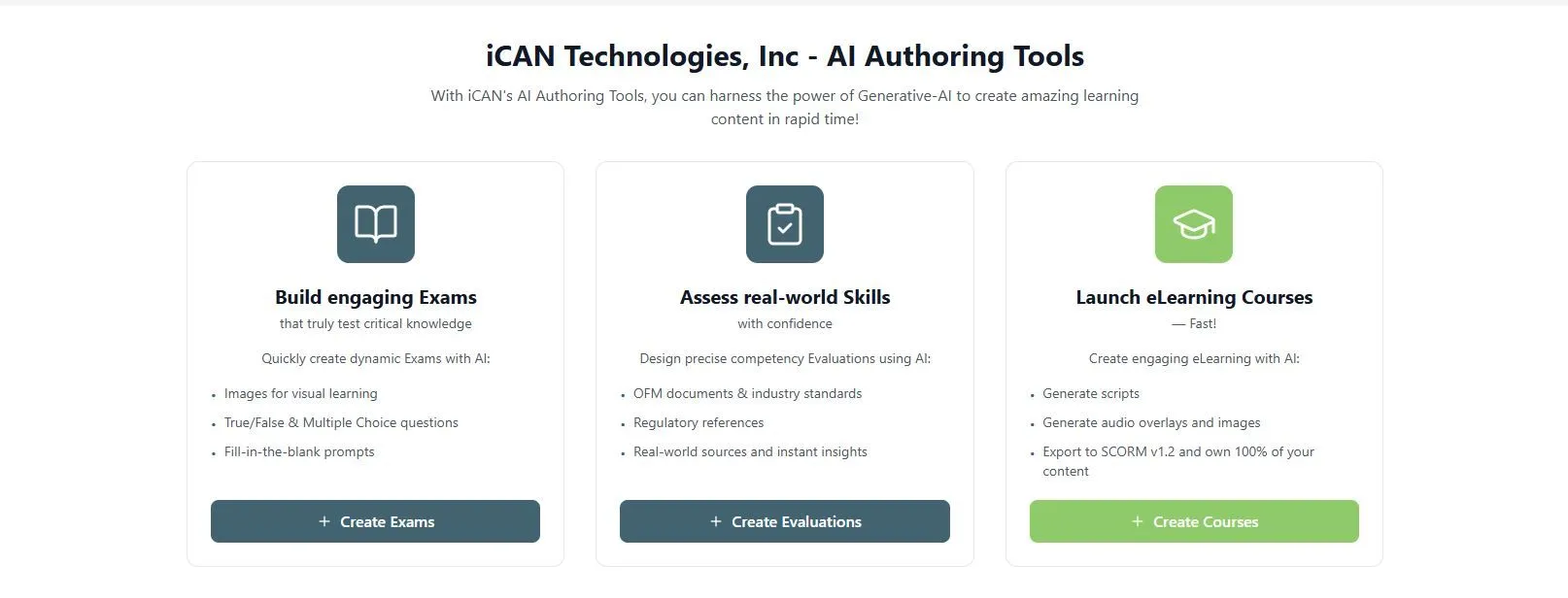
With iCAN AI Authoring Tools, organizations can work from policies, procedures, manuals, videos, and other accepted content to create training and assessments tailored to their operations.
2. Convert the Content Into Interactive Learning
The AI reviews the source material and organizes it into a structured learning experience.
Depending on the tool, the output may include:
- Interactive eLearning lessons
- Learning objectives
- Knowledge checks
- Scenario-based questions
- Exams
- Answer keys and explanations
- Competency evaluations
- Audio, images, and other learning elements
- Multiple-language versions
The purpose is not to make a document look like a course.
The purpose is to turn information into a learning path that helps employees understand what they must know, what they must do, and how performance will be evaluated.
3. Have Subject-Matter Experts Review and Approve
AI should accelerate development, not remove accountability.
A qualified SME, safety professional, operations leader, or technical expert must review safety-critical content before deployment.
The review should confirm that:
- Critical steps remain accurate
- Equipment names and specifications are correct
- Warnings and exceptions are included
- Regulatory references are current and appropriate
- Assessment answers match the approved procedure
- The training reflects the actual job and work environment
A strong AI content authoring process gives reviewers a clear approval workflow and makes revisions easy to manage.
This step protects both the learner and the organization.
4. Deploy, Assign, and Track
After approval, publish the training to your LMS or connected learning environment.
Look for support for common delivery standards, including SCORM 1.2 or 2004 where required, along with mobile access and blended learning options.
Then assign the course by role, location, department, equipment, or other workforce requirements.
A connected system should track more than completion.
It should connect the source procedure to the training, assessment, result, qualification status, and next development action.
What to Demand From an AI Authoring Tool
Not every AI course builder is appropriate for technical or regulated workforces.
Use these criteria when evaluating a tool.
Accuracy Grounded in Your Documents
The tool should generate content from approved source materials and make the source traceable.
It should not confidently add unsupported procedures or regulatory claims.
SME Review and Approval
Your experts need to review, edit, approve, reject, and update generated content before employees use it.
Assessments That Test Applied Knowledge
The tool should support scenario questions and job-specific decisions, not only simple recall questions.
Standards and LMS Compatibility
Ask whether the tool supports the formats and systems your organization already uses, including SCORM, AICC, video, linked policies, and mobile delivery.
Multilingual Support
Technical workforces are often multilingual.
The authoring process should support multiple languages while preserving the meaning of safety instructions and assessments.
Full Content Ownership and Export
Your organization should retain ownership of the content created from its materials.
You should also understand how to export courses, records, and data if your technology strategy changes.
iCAN states that customers retain 100% ownership of content created from their uploaded materials.
Competency-Based Training Versus Completion-Based Training
A completion record answers one question:
Did the employee finish the course?
That question matters, but it does not prove that the employee understands the work or can perform it correctly.
Competency-based training goes further.
It defines the knowledge and skills required for a role, teaches those requirements, evaluates performance against them, and identifies what needs to happen next.
The assessment design is central.
A recall question might ask an employee to identify a definition from a manual.
An applied-knowledge question might present a work situation and ask the employee to determine the correct next action based on the approved procedure.
Scenario-based assessments are not a substitute for hands-on observation where practical demonstration is required.
They are one part of a broader competency process.
The important distinction is that the assessment should measure the decisions and behaviors the job requires.

The Ownership Question
Generic, off-the-shelf content can help with broad topics.
It may not reflect your site-specific procedures, equipment, terminology, or risk controls.
That creates a problem when employees need to apply training in a particular work environment.
Your organization has invested in its procedures and operational knowledge.
An AI authoring tool should help you activate that knowledge without giving up control of it.
With iCAN, your existing content can become customized eLearning, exams, and competency assessments while remaining owned by your organization.
This supports a more practical model: use your procedures as the source, have your experts approve the result, and maintain the training as the source content evolves.
Where AI Authoring Fits With a CMS and LMS
AI authoring is most valuable when it connects to the rest of your workforce development process.
The workflow can be summarized as:
Create → Know → Prove → Improve
- Create: Transform procedures, manuals, and policies into training and assessments.
- Know: Use a Competency Management System to see required skills, results, qualifications, and gaps.
- Prove: Connect assessment evidence to competency and readiness decisions.
- Improve: Assign targeted development, reassess employees, and track progress.
The LMS delivers and tracks learning.
The Competency Management System shows what the workforce knows, where gaps exist, and how results compare with organizational requirements and available industry benchmarks.
The connection matters because training completion is only one part of workforce readiness.
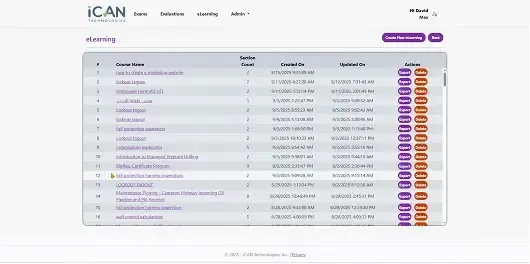
iCAN’s platform connects content, training, assessments, competency evidence, and workforce insights in one workflow.
Frequently Asked Questions
What is an AI eLearning authoring tool?
An AI eLearning authoring tool uses artificial intelligence to help transform source materials such as manuals, policies, and procedures into structured eLearning courses, assessments, exams, and competency evaluations.
Can AI turn a PDF or Word manual into an eLearning course?
Yes, an appropriate tool can use a PDF or Word manual as source material for lessons, learning objectives, knowledge checks, and assessments, subject to human review and approval.
Is AI-generated training accurate enough for safety-critical content?
AI-generated training should be treated as a draft until a qualified subject-matter expert reviews and approves it.
The SME must verify procedures, warnings, exceptions, regulatory references, equipment details, and assessment answers.
What is competency-based training?
Competency-based training develops and evaluates the knowledge and skills required to perform a role, rather than measuring course completion alone.
Who owns the content created with an AI authoring tool?
Ownership depends on the provider’s terms.
Organizations should choose a platform that clearly protects their rights to uploaded materials and generated content, including export options.
Turn Existing Knowledge Into Proven Competency
Your safety manuals already contain valuable knowledge.
The challenge is making that knowledge teachable, assessable, and connected to workforce decisions.
An AI eLearning authoring tool can help your team move from static documents to interactive training faster.
The strongest approach combines source-grounded AI, SME approval, applied assessments, content ownership, and connected competency management.
See how iCAN can transform one of your procedures into training, exams, and competency insight through a free 14-day trial.
You can also book a demo to discuss your workforce development requirements.