
"An Easy Button for Compliance and Skill Validation": The PROVE Story From the Field

“We needed a competency system that worked for real field operations. iCAN's mix of iCAN Academy and competency tracking gave us an easy button for compliance and skill validation.”
: Derek, Murphy Oil, Safety & Operations Lead
The gap between trained and qualified
For a Safety & Operations Lead, a completion record is only the beginning.
The real question is whether field personnel can perform the work safely, correctly, and independently.
That distinction matters in energy, utilities, manufacturing, chemical processing, and healthcare.
A worker may have completed a course, passed a quiz, and received a certificate.
That does not always prove the worker can apply the procedure on the job.
Field operations demand more.
They require evidence that connects training to the role, the task, and the authority to perform the work.
That is the PROVE pillar.
What PROVE means for your operation
PROVE means having defensible evidence when regulators, auditors, and operations leaders ask a direct question:
Can this person perform the work they are assigned to do?
A strong compliance process should make that answer clear.
It should show current certifications.
It should flag upcoming expirations.
It should preserve audit trails.
It should record assessment results.
It should connect each result to the employee’s role, competency, and task authority.
It should also make the evidence easy to find and export.
For organizations operating under BSEE regulations and Subpart O, that visibility can be especially important during inspections, training system audits, and incident reviews.
Subpart O focuses on training, performance verification, and documentation for covered well control and production safety duties.
A completion record can show that training occurred.
A validated competency record can show what the employee was assessed on, when the assessment occurred, and whether the employee met the defined standard.
Those are not the same thing.
Completion is not validation
Training completion answers one question:
Was the training assigned and completed?
Skill validation answers another:
Can the employee demonstrate the required capability?
The difference is simple, but it has operational consequences.
A course completion report may show that an employee watched a module last year.
It may not show whether the employee understands a revised procedure, retained the knowledge, or can perform the task under real operating conditions.
That is why technical workforces need more than a traditional learning record.
They need a connected view of training, assessment, qualification, and ongoing competency.

How iCAN helps you PROVE readiness
iCAN brings together a data-driven Learning Management System and an AI-powered Competency Management System.
Together, they create one operational record for workforce development and compliance.
The LMS delivers and tracks the work
The LMS supports classroom learning, on-the-job training, safety meetings, and eLearning in one environment.
It helps teams assign training by role, site, contract, or other operational requirements.
It tracks completion and certification status in real time.
It sends expiration alerts and supports automatic reassignments.
It also provides exportable reports for audits, customers, insurers, and regulators.
This gives training and HSE leaders a current view of workforce compliance without searching through disconnected spreadsheets, emails, or paper files.
The CMS validates capability
The Competency Management System adds the proof behind the completion record.
It captures assessments and evaluations in real time.
It maps competencies to roles and operational expectations.
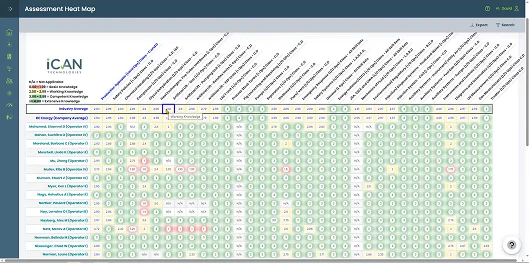
It visualizes workforce strengths and gaps through live dashboards and heat maps.
It also supports comparison against internal standards and industry benchmarks.
That industry benchmarking gives leaders additional context.
You can see where your workforce meets expectations, where gaps exist, and where targeted development may be needed.
The result is a clearer picture of readiness across people, teams, sites, and roles.
Training content should reflect the real work
Validation is only as useful as the standard behind it.
Generic eLearning may explain a broad concept.
It may not reflect your equipment, procedures, controls, terminology, or work environment.
That creates a problem for technical organizations.
If the evaluation does not match the work, the result may not provide meaningful evidence of field capability.
iCAN Academy AI authoring tools help organizations turn their own SOPs, policies, procedures, and technical manuals into interactive courses, exams, and competency evaluations.
Your subject matter experts provide the source material.
The platform helps transform that material into structured learning and assessment content.
That means your evaluations can be built around the procedures your workforce is expected to follow.
It also means your organization retains ownership of the content created.

An easier path to audit-ready evidence
Compliance work becomes harder when evidence lives in multiple systems.
One spreadsheet tracks certifications.
A supervisor keeps paper assessment forms.
A training coordinator maintains course completions.
Another team stores audit documents in a shared drive.
That process creates delays and uncertainty.
It also makes it harder to answer basic operational questions quickly.
Who is qualified for this task?
Which certifications expire soon?
Who still needs validation?
Which assessment standard did the employee meet?
Can we produce the supporting record?
With iCAN, training delivery, compliance status, competency assessments, and reporting work together.
Leaders gain real-time visibility.
Training teams gain a unified system of record.
Operations leaders gain clearer insight into who is ready for assigned work.
Auditors receive organized evidence instead of a collection of disconnected files.
That is the practical meaning of an “easy button.”
It does not remove the responsibility to train, assess, and verify people.
It makes the process easier to manage and the evidence easier to prove.
The PROVE story from the field
Derek’s testimonial captures a challenge many technical organizations understand.
Field operations do not fit neatly into an HR-only training model.
Competency must connect to the work itself.
It must account for the roles people hold, the tasks they perform, and the standards they must meet.
It must remain visible after the course is complete.
And when an inspection or incident review occurs, the organization must be able to produce evidence that stands on its own.
iCAN Academy helps teams build relevant learning and evaluation content from their own materials.
The LMS helps deliver, assign, and track that content.
The Competency Management System helps validate skills, identify gaps, benchmark performance, and maintain current readiness data.
The three capabilities work together to support a more defensible approach to compliance.
See how iCAN can support your workforce
If your organization needs a clearer connection between training completion and verified capability, book an iCAN demo.
If you want to explore AI-powered content creation, try iCAN Academy free for 14 days.
Your field teams deserve training that reflects the work they perform.
Your leaders deserve visibility into workforce readiness.
And your organization deserves evidence it can stand behind.
If your current tools have made compliance and skill validation harder than they should be, we are sorry.
You deserve a clearer way to prove readiness.