
Competency Based Training: What It Really Means and How to Build a Program That Holds Up

Competency based training is a learning approach in which employees develop and demonstrate specific, job-related abilities to a defined standard.
The term gets used loosely. A completed course, a passed quiz, or a certificate may show that someone participated or retained information. On its own, none of those proves that the person can perform a task safely and correctly.
A credible competency based training program defines the competencies required for each role, verifies performance against clear criteria, records the evidence, and sets a plan for re-verification. That difference matters in technical and regulated environments, where capability can affect safety, quality, compliance, and operational readiness.
Competency based training vs. traditional training
Traditional training commonly measures participation and completion. Competency based training measures whether a person can apply the required knowledge and skills.
| Traditional training model | Competency based training model |
|---|---|
| Focuses on course attendance and completion | Focuses on demonstrated capability |
| Often uses the same learning path for everyone | Aligns learning and assessment to roles and tasks |
| May rely mainly on completion records or knowledge tests | Uses evidence suited to the competency, including practical demonstration when needed |
| Records that training took place | Records what was assessed, the result, and supporting evidence |
| May treat completion as the endpoint | Includes development and re-verification where appropriate |
Training still matters. It helps people build the knowledge and practice they need. But it is not the same as assessment: a course supports capability, while a competency assessment gathers evidence to determine whether someone meets a defined standard.
For a practical task, evidence might include an observed demonstration, a completed work product, or answers to questions about decisions and safety controls. A knowledge quiz can be useful, but it may not show whether someone can perform the task.
The four building blocks of a competency based training program
1. A competency framework mapped to roles
Start by defining what people need to do in each role. Map competencies to relevant tasks, equipment, procedures, and operating conditions.
A framework helps managers see where requirements overlap and where they differ. It can also clarify prerequisites, assessor responsibilities, and which roles need reassessment after a change.
2. Assessments that test applied knowledge and demonstration
Choose an assessment method that fits the competency. A written test may check procedural knowledge; an observed task may be necessary to verify hands-on performance.
Define the expected standard before assessment begins. Include the conditions, criteria for a pass, and any critical errors that would require a fail or further development.
3. Evidence and records that stand up to review
A result is more useful when the organization can explain what it means. Keep records that connect the requirement to the assessment, evidence, outcome, assessor, and relevant procedure or equipment version.
Clear records support qualification decisions, development planning, and audit preparation. The specific documentation requirements depend on the organization’s industry, jurisdiction, and applicable standards.
4. A re-verification cadence
Competency can change as procedures, equipment, responsibilities, and regulations change. A pass today does not necessarily prove readiness indefinitely.
Set re-verification intervals based on risk, applicable requirements, task frequency, performance history, and changes to the work. Also consider reassessment when a procedure changes or a performance issue identifies a possible gap.
How to write competencies that actually work
A useful competency statement describes observable performance. It should identify the task, relevant conditions, and what acceptable performance looks like.
Avoid vague language such as “understands safety procedures” or “has good equipment knowledge.” Those phrases are difficult to assess consistently because they do not say what the person must do.
Instead, describe an action and a standard. For example: “Before servicing the assigned equipment, apply the required isolation steps, verify the isolation using the approved method, and document the result according to the current procedure.”
The competency should also identify the equipment or context when those details matter. “Operates equipment safely” is too broad if the actual task depends on a specific make and model, process, or work condition.
Ask three questions when reviewing a competency:
- Can an assessor observe or otherwise verify the required performance?
- Can the person being assessed tell what the standard requires?
- Can the organization connect the result to a role, task, and relevant evidence?
How technology supports competency based training
A competency management system can bring frameworks, assessments, results, records, and development plans together. Instead of relying on separate spreadsheets or scattered files, leaders can use connected information to understand where employees stand and what follow-up is needed.
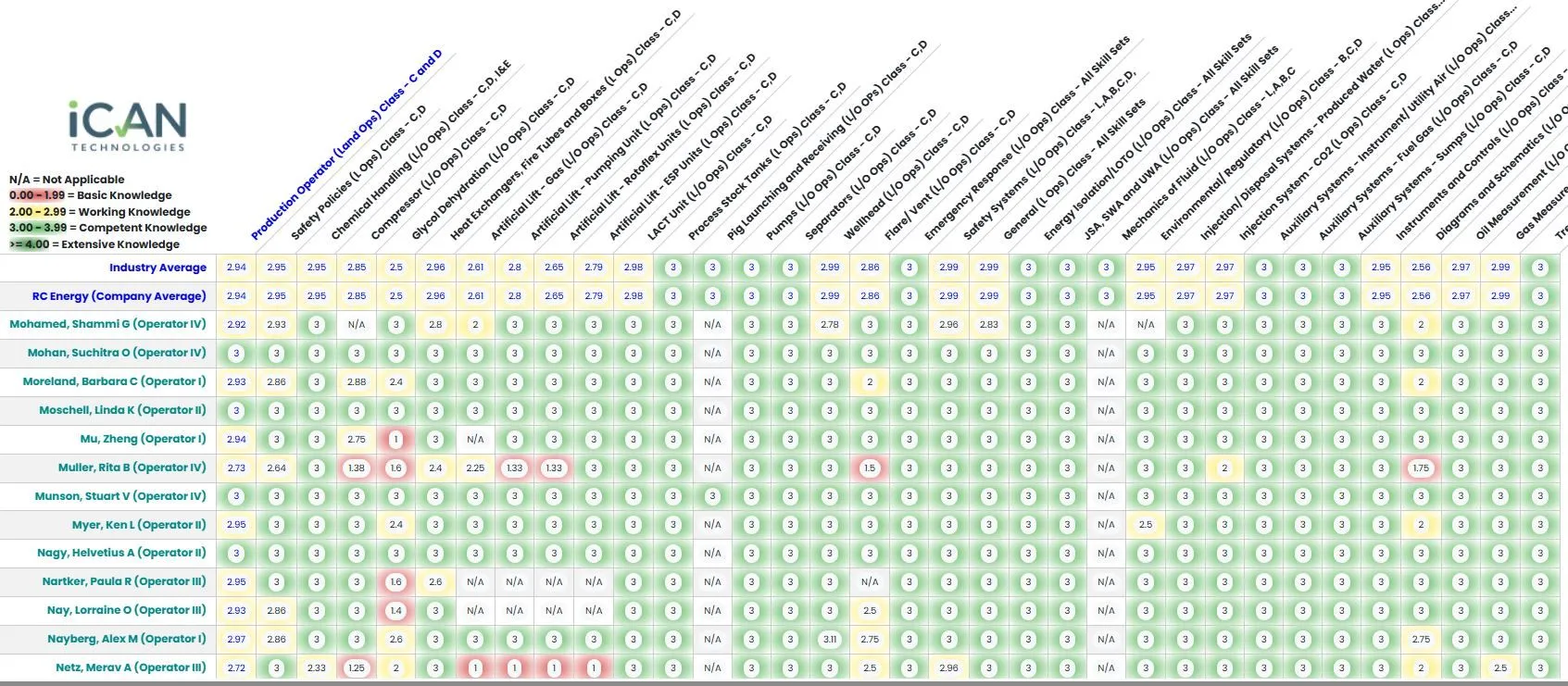
Heat maps can help show gaps across roles, teams, or locations. When the system supports equipment-level context, organizations can also see where readiness is linked to specific equipment requirements. The goal is not to replace sound assessment; it is to make competency information easier to maintain and act on.
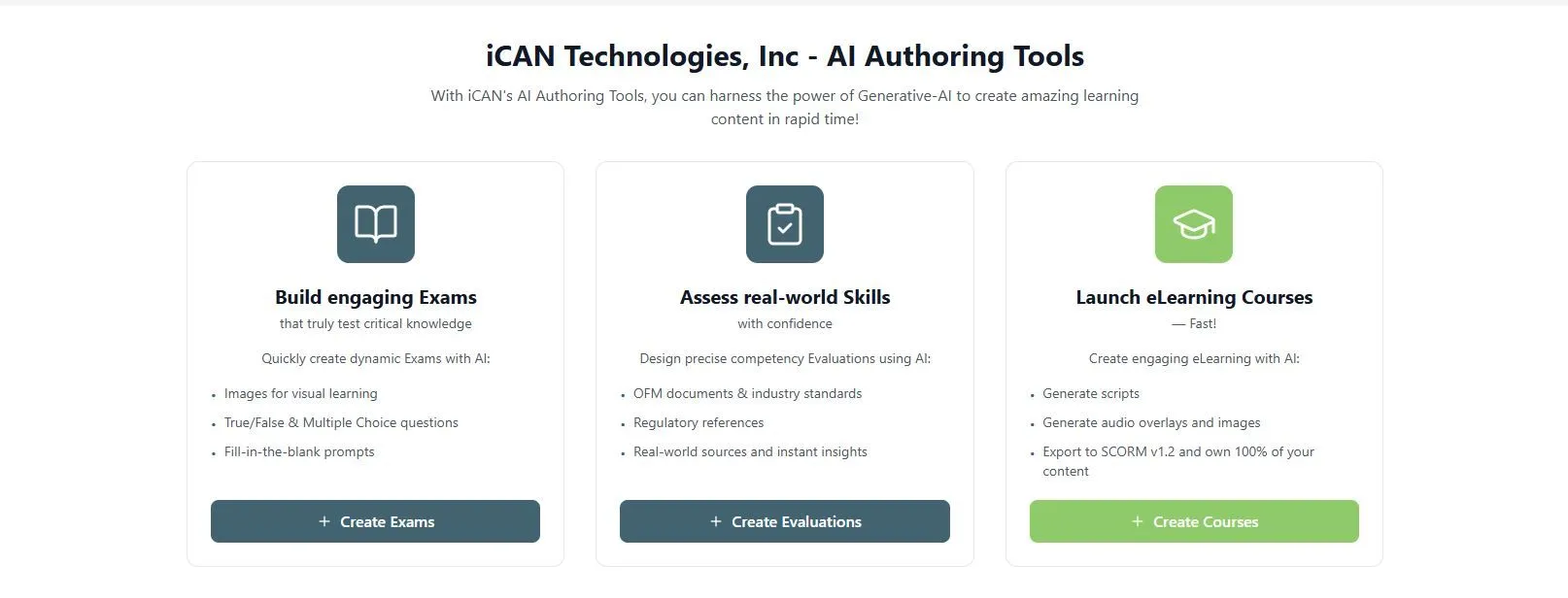
AI authoring can help teams create learning and assessment materials from existing procedures, policies, and technical manuals. iCAN’s AI Authoring Tools support turning source content into courses, exams, and competency assessments. Subject-matter experts should still review the output to confirm that it reflects current procedures and the actual performance standard.
Together, these capabilities can help connect source requirements to training, competency assessment, evidence, and targeted development. iCAN’s industry benchmarking can also provide context by comparing results with available anonymized industry assessment data; it does not replace an organization’s own standards.
Common mistakes to avoid
- Treating a certificate as proof of competency. A certificate may confirm course completion or qualification under a defined process, but check what was actually assessed.
- Using knowledge quizzes as the only assessment. Quizzes test knowledge, not necessarily hands-on execution or judgment in context.
- Skipping re-verification. Skills, processes, equipment, and requirements can change; plan how competency will be reviewed over time.
- Writing competencies too broadly. If requirements are not tied to relevant tasks, equipment, and conditions, assessment results may not show readiness for the work at hand.
- Recording a score without its context. Keep enough information to understand the competency, assessment method, evidence, and decision.
Where to start: a five-step rollout
- Set the scope. Select a role, site, or high-priority task, and identify the applicable procedures and requirements.
- Map the work. Confirm tasks, equipment, conditions, risks, and required performance with supervisors and subject-matter experts.
- Define competencies and evidence. Write observable standards and choose an assessment method that fits each requirement.
- Pilot the program. Test the assessments with a small group, gather feedback, and check whether different assessors can apply the standards consistently.
- Track and improve. Review results, identify gaps, assign targeted development, and set risk-appropriate re-verification triggers.
Regulatory expectations vary by sector and jurisdiction. For example, 21 CFR 211.25 addresses personnel qualifications and training in drug manufacturing, while 29 CFR 29.5 sets standards for registered apprenticeship programs. These examples do not establish a universal rule for every organization. Check the requirements that apply to your work and have qualified compliance or legal professionals review your program.
Frequently asked questions
What is competency based training?
Competency based training prepares employees to meet defined job requirements and verifies their ability through evidence, not attendance alone.
How is it different from traditional training?
Traditional training often tracks participation and course completion. Competency based training assesses whether a person can perform required tasks to a defined standard.
How do you assess competency?
Select methods that fit the task and criteria. Depending on the competency, that may include observation, practical demonstration, a knowledge check, a work product, or a combination.
How often should competency be re-verified?
There is no single interval for every task. Set a cadence based on risk, applicable requirements, performance, task frequency, and changes to procedures or equipment.
Does competency based training satisfy regulatory requirements?
Not automatically. Requirements depend on the regulation, industry, and jurisdiction. Map your program to applicable requirements and confirm that your training, assessment, and records meet them.
Build a program around demonstrated capability
A strong competency based training program connects role requirements to clear standards, fit-for-purpose assessments, reliable evidence, and ongoing review. It gives employees a clearer development path and gives leaders a more useful view of workforce readiness.
To see how iCAN connects competency management, assessment visibility, and AI-supported content development, book a demo.