
Expired Certifications and Unmonitored CBT: The Compliance Blind Spots Auditors Are Finding Offshore

Wow: offshore training records can look complete while workforce readiness remains unclear.
That is the central lesson from MMA Safety Alert 524, “Improvements Needed In Production Safety System Training,” published through the Bureau of Safety and Environmental Enforcement.
During recent Subpart O audits in the Gulf of America Region, the Marine Minerals Administration identified gaps in Production Safety System Training, or production safety training, across employees, contractors, training providers, and emergency response activities.
The findings point to more than a course-content problem.
They expose a compliance management problem.
If an operator cannot quickly see who is certified, who is current, who is approaching expiration, what training a contractor completed, and how knowledge was verified, the program has a blind spot.
The audit findings were measurable
The Performance-Based Risk Inspection covered 16 assets operated by 11 unique operators.
Inspection teams administered 53 written tests covering production safety systems, device identification, operating ranges, safety set points, documentation, calculations, and emergency-related knowledge.
The results showed significant variation:
- The average score was 80.34.
- 20 individuals, or 38% of those tested, scored below 80%.
- Five individuals, or 9% of those tested, scored below 70%.
The alert also identified specific knowledge gaps involving pressure recording devices, Safety Analysis Function Evaluation Charts, surface-controlled subsurface safety valves, flowline safety valves, boarding shutdown valves, gas blowby protection, pressure safety high and low settings, gas detection alarms, and other production safety requirements.
These topics are not abstract learning objectives.
They relate directly to the devices, limits, tests, records, and decisions that support safe offshore production.
The most serious gaps were not hidden in the test questions
The alert described several conditions that should concern every HSE manager and training leader.
One production operator had less than three years of experience and had completed only refresher training, not a full production safety training course.
Another operator held an expired production safety training certification.
Some computer-based training was not monitored.
Some refresher training relied on a limited knowledge quiz and observation assessment when in-person training was restricted during the COVID-19 pandemic.
Training provider scores also did not tell the whole story.
Industry training providers reported an average score of 95.49 for the offshore employees tested, while the same employees averaged 80.8 on the MMA-administered test.
That difference matters.
A completion record or provider test score does not automatically prove that a person understands the organization’s procedures or can perform a production safety duty correctly.
Completion is not the same as competency
A computer-based course can show that a learner opened the module, answered questions, or reached the final screen.
It may not show whether the learner can identify the correct device, interpret an operating range, calculate a required set point, complete a test record, or respond during an abnormal operating condition.
That distinction becomes more important when training is generic, outdated, or disconnected from the facility where the work occurs.
The alert specifically called for operators to verify employee and contractor understanding and performance.
That requires more than assigning training and storing a certificate.
It requires a connected process for assigning the right learning, assessing knowledge, evaluating practical performance, recording the result, and following up when someone does not meet the required standard.
Expiration tracking cannot depend on spreadsheets
An expired certification is not always caused by negligence.
It can result from a transfer between facilities, a contractor change, a missed reminder, an incomplete renewal, or a record that never made it into the right system.
The operational risk is the same.
Someone may appear active in the workforce while their required qualification is no longer valid.
Manual spreadsheets and disconnected systems make these gaps harder to see.
They also make audit preparation slower because teams must reconcile records across departments, locations, contractors, and training providers.
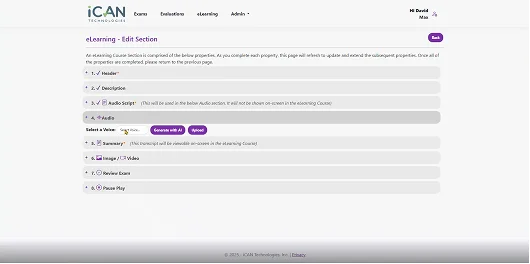
iCAN’s Data-Driven LMS provides unified compliance management for classroom, online, and on-the-job training.
It can support:
- Role-, site-, and contract-based training assignments.
- Certification records and expiration monitoring.
- Alerts and reminders for renewals.
- Automatic reassignments.
- Attendance and completion tracking.
- Training matrices and real-time dashboards.
- Audit-ready reporting and data exports.
- Visibility into contractor training and compliance status.
- Complete records of assignments, results, evaluations, and approvals.
The goal is simple.
Managers should not have to ask several people for a current training status report when a safety decision or audit request arrives.
They should be able to see the status directly.
Contractor training needs the same level of control
The alert identified failures to evaluate contractor training and limited procedures for verifying contractor training needs.
That creates a familiar challenge for offshore operators.
A contractor may arrive with a certificate, but the certificate may not show whether the training matches the operator’s procedures, asset-specific risks, assigned duties, or current requirements.
Contractor records may also sit outside the operator’s primary LMS.
That makes it difficult to confirm whether the person is current before work begins.
A unified LMS can give operators a consistent way to define requirements by role, contract, site, or customer expectation.
It can also provide a documented record of what was assigned, what was completed, when it was completed, and whether the required assessment or verification occurred.
This does not eliminate the operator’s responsibility to evaluate training programs.
It gives the operator a stronger system for managing and documenting that evaluation.
Content must reflect the organization’s real work
Tracking alone cannot correct outdated or generic learning content.
If a course refers to old procedures, obsolete equipment, incorrect alarm arrangements, or another organization’s operating assumptions, the LMS may track it perfectly while the workforce learns the wrong information.
This is where iCAN’s AI Authoring Tools support the compliance process.
Teams can use existing policies, procedures, technical manuals, OEM documents, and safety guidelines to create organization-specific eLearning, exams, and competency evaluations.
The approach helps address three common content problems:
- Outdated material: When a procedure changes, the training team can update the source-based course instead of waiting for a vendor’s revision cycle.
- Generic material: Courses can reflect the organization’s terminology, equipment, controls, procedures, and expectations.
- Limited verification: The same source material can support knowledge checks, exams, and evaluations designed around real work.
Organizations retain ownership of the content they create.
That matters when procedures change, contractors need targeted training, or an auditor asks how a course connects to current operating requirements.

The Competency Management System adds another layer of evidence
A certification confirms that a requirement was completed within a defined period.
It does not necessarily show how well a person performs against the competency expected for the role.
iCAN’s Competency Management System helps organizations capture assessments, visualize skill gaps, and compare workforce performance against internal and industry standards.
That industry benchmarking capability can help leaders identify whether a result reflects an isolated issue or a broader competency trend.
For example, a manager may discover that a team is current on production safety training assignments but consistently struggles with device labeling, pressure set-point calculations, documentation, or emergency procedures.
The organization can then create a targeted development plan, assign source-based learning, conduct a practical evaluation, and reverify competency.
The result is a closed loop:
- Create training from current organizational knowledge.
- Assign it to the people and contractors who need it.
- Measure knowledge and practical performance.
- Compare results against defined standards and industry benchmarks.
- Target development where gaps appear.
- Track renewal and reverification over time.

Emergency drills require visible verification too
The MMA inspection teams also found weaknesses in fire drill execution and documentation.
Some personnel were unfamiliar with deploying inflatable life rafts.
Some facilities experienced delayed responses because personnel could not hear fire alarms over machinery noise.
Some loudspeakers were not loud enough to be heard throughout the facility.
Some drill records did not include facility abandonment, realistic uncontrollable fire scenarios, or analysis and critique of the drill.
These findings reinforce the need to track more than course completion.
A compliance system should help document attendance, drill type, scenario, observations, corrective actions, follow-up assignments, and re-verification.
The alert recommends reviewing fire drills against 30 CFR 250.1918(c) and the operator’s Safety and Environmental Management System program.
A connected record makes it easier to show what happened during the drill and what the organization did afterward.
Audit readiness is a continuous process
The alert recommends that operators review internal procedures, confirm production safety training requirements, align frequency with the three-year industry standard, evaluate training providers, verify contractor competency, train personnel on lifesaving equipment, confirm alarm effectiveness, and review recent fire drills.
Those actions require more than a document repository.
They require current information.
A data-driven LMS gives managers a way to maintain that information continuously.
AI authoring helps keep learning tied to current procedures.
The Competency Management System helps verify whether people can apply what they learned.
Unified compliance management keeps assignments, certifications, expiration dates, contractor records, assessments, and audit trails connected.
Together, the ecosystem helps close the gap between training assigned, training completed, and competency demonstrated.
That is the gap the MMA findings brought into focus.
Start with the blind spots you can already identify
Begin by asking five questions:
- Can we identify every employee and contractor who performs production safety duties?
- Can we see who is current, expiring, expired, or missing required production safety training training?
- Can we prove that computer-based training was monitored and assessed?
- Can we show how contractor training was evaluated against our requirements?
- Can we connect training records to knowledge checks, practical evaluations, drills, and corrective actions?
If the answers require manual searches, the process may be exposing the organization to avoidable risk.
See how iCAN can help with unified compliance management, competency benchmarking, and organization-specific content creation.
You can book a demo or try iCAN’s AI authoring tools free for 14 days.
Source
This article is based on MMA Safety Alert 524: Improvements Needed In Production Safety System Training, issued and published by BSEE on August 19, 2026.
Alternative title options
- What Offshore production safety training Audits Reveal About Expired Certifications and Training Visibility
- From Training Records to Proven Competency: Closing Offshore Compliance Gaps
- The Offshore Training Audit Checklist: Certification Status, Contractors, CBT, and Drill Readiness