
Your Training Provider Says 95. The Regulator Says 80. That Gap Is Your Risk.

That is a serious gap.
A training provider can report excellent scores while a regulator uncovers weak retained knowledge in the same workforce.
Recent findings from the Bureau of Safety and Environmental Enforcement’s Safety Alert No. 524, “Improvements Needed in Production Safety System Training” show why offshore operators need to measure competency continuously, not rely on course completion or a single certificate.
The number that should get every HSE leader’s attention
During a Performance-Based Risk Inspection covering 16 assets operated by 11 operators, inspection teams administered 53 written tests on Production Safety System Training.
The test covered far more than basic recall.
It included definitions, device labeling, practical questions, calculations, and multiple-choice questions related to production safety systems.
The alert reported an average score of 80.34, with results ranging from 63.1 to 91.6.
Twenty people, or 38% of those tested, scored below 80%.
Five people, or 9%, scored below 70%.
The most revealing comparison came from employees who had already completed industry training.
Industry training providers reported an average score of 95.49 for those employees.
The same offshore employees averaged 80.8 on the regulator-administered test.
That is a 14.69-point difference.
The issue is not simply that one test was harder than another.
The deeper issue is that a provider’s assessment can show how well someone performed inside a specific course, while a regulator’s assessment can reveal whether the person retained and can transfer that knowledge to real production safety situations.
A high course score does not automatically prove operational readiness.
Completion is not the same as competency
A certificate answers one question.
Did the employee complete the assigned training?
It does not always answer the questions that matter most offshore.
Can the employee identify the correct safety device?
Can the employee explain why a Safety Analysis Function Evaluation Chart matters?
Can the employee calculate an appropriate pressure safety high or low set point?
Can the employee recognize when flowline requirements change because Shut-In Tubing Pressure exceeds Maximum Allowable Working Pressure?
Can the employee explain the required documentation for a Surface-Controlled Subsurface Safety Valve test?
These are competency questions.
They require understanding, application, and retention.
The alert identified gaps across pressure recording devices, operating ranges, SCSSV closure times, incoming pipeline devices, flowline safety valve test tolerances, boarding shutdown valve requirements, gas blowby protection, tubing plug leakage test intervals, abnormal operating conditions, pressure safety set points, and gas detection alarm requirements.
Those gaps can remain hidden when organizations track only course assignments, completion dates, and provider-issued scores.
A workforce may appear compliant in the LMS while managers lack a clear view of who can perform the work correctly.
Point-in-time testing creates blind spots
The alert also described several conditions that make point-in-time certification especially risky.
One production operator with less than three years of experience had completed refresher training but had never completed a full production safety training course.
Another operator had an expired production safety training certification.
In some cases, refresher training had been reduced to a limited knowledge quiz and observation assessment when in-person training was restricted during the COVID-19 pandemic.
These examples show how training systems can drift away from the actual requirements of a role.
New employees may enter refresher pathways before building foundational knowledge.
Expired certifications may remain undiscovered until an audit.
Reduced assessments may continue long after the original operational constraint has passed.
Contractors may receive training through separate providers without consistent evaluation by the operator.
The result is fragmented visibility.
Each individual record may look complete, but the organization still cannot confidently answer whether the workforce is ready.
How iCAN’s Competency Management System changes the question
iCAN’s Competency Management System shifts the focus from “Who completed training?” to “Who is demonstrably competent for this role, site, and task?”
The system captures assessment and evaluation results in real time.
It then organizes that information into a live view of workforce capability.
Managers can review:
- Competency by role, location, department, or asset.
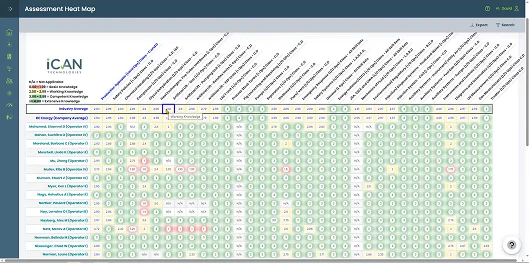
- Assessment heat maps that reveal concentrated skill gaps.
- Individual and team performance trends.
- Expiring or incomplete requirements.
- Development progress over time.
- Competency comparisons against company and industry standards.
This visibility helps HSE managers identify a problem before it becomes a regulator’s test result.
A site-level heat map could show that production operators understand basic terminology but struggle with pressure safety calculations.
Another could reveal that contractors perform well on equipment identification but lack documented proficiency in testing procedures.
A role-based view could show that newer employees have entered a refresher pathway without completing the full foundational curriculum.
The value comes from seeing the pattern, not just the individual record.
Benchmarking shows where your workforce truly stands
Internal standards are necessary.
They are not always sufficient.
An organization may set an 80% passing score and consider the requirement satisfied.
That score does not show how the workforce compares with similar technical teams.
It also does not show whether the assessment itself measures the knowledge that matters in the field.
iCAN’s Competency Management System adds industry benchmarking against the largest Gulf of Mexico competency dataset.
This gives operators a broader reference point for understanding workforce readiness.
Benchmarking can help answer practical questions:
- Are our production safety teams performing below, near, or above industry expectations?
- Which competencies create the largest gap between our workforce and peer performance?
- Are certain roles, assets, or contractors consistently underperforming?
- Are our assessments testing practical application or only course recall?
- Did a corrective action improve competency after the intervention?
The 95.49 versus 80.8 comparison in the alert demonstrates why this context matters.
A provider score can look strong in isolation.
A benchmarked competency result can reveal whether that performance transfers beyond the course environment.
With the right data, operators can prioritize development based on risk rather than assumption.
Targeted development is more effective than repeating the same course
When a gap appears, the answer is not always to assign the entire course again.
Repeating generic training may consume time without addressing the specific weakness.
A better approach is to connect each gap to a targeted development plan.
For example, a team struggling with pressure safety high and low settings may need focused practice with operating ranges and set-point calculations.
A group with weak SCSSV knowledge may need a targeted module covering closure times, testing requirements, and documentation.
A contractor workforce with inconsistent knowledge may need role-specific evaluations aligned with the operator’s procedures.
iCAN can generate development plans from assessment data, track progress, and support re-verification across the employee lifecycle.
That creates a continuous loop:
- Assess the competency.
- Identify the specific gap.
- Assign targeted development.
- Reassess performance.
- Confirm renewed competency.
- Monitor the trend.
This process gives managers evidence that corrective action improved capability rather than simply recording another completion.
Outdated and generic eLearning creates another layer of risk
The content itself can also create a gap.
Pre-packaged eLearning may explain production safety systems in broad terms while failing to reflect an operator’s actual procedures, equipment, terminology, or site conditions.
Outdated content creates a similar problem.
A course may still reference an old procedure, an obsolete device configuration, or a previous testing interval.
Employees can complete that course successfully and still receive the wrong operational guidance.

iCAN’s AI Academy Tools help organizations turn their own policies, procedures, technical manuals, OEM documents, and safety guidelines into customized learning content.
The tools can help create:
- Role-specific eLearning courses.
- Exams with multiple-choice, true-or-false, and fill-in-the-blank questions.
- Device-labeling and knowledge assessments.
- Competency evaluations aligned with SOPs and technical requirements.
- SCORM-compliant content for deployment through an existing LMS.
The important distinction is ownership and relevance.
Organizations can build training from the documents their employees actually use.
When a procedure changes, the source content can be updated and the associated learning materials revised instead of waiting for a third-party provider’s next course release.
AI accelerates the work.
Subject matter experts still review and approve the final content.
That combination helps operators move faster without giving up procedural control.
Build an audit-ready competency record
The alert recommends reviewing internal procedures, confirming production safety training certification requirements, evaluating training providers, verifying contractor training, and documenting knowledge and skill retention.
Those actions require more than a completion report.
They require connected evidence.
An effective competency record should show the applicable role requirements, the training completed, the assessment results, the observed performance, the identified gaps, the development assigned, and the follow-up verification.
It should also make clear whether an employee or contractor is currently ready to perform the required work.
That is the difference between storing training records and managing competency.
The regulatory lesson is direct.
If the training provider says 95 but the regulator finds 80, the certificate did not tell the whole story.
iCAN helps operators see the rest of the story before an inspection does.
Start with the gap you cannot see today
Review your current production safety training process and ask three questions.
Are we measuring retained and transferable knowledge?
Can we see competency by role, asset, contractor, and site?
Can we compare our performance against relevant Gulf of Mexico industry benchmarks?
If the answer to any of these questions is unclear, book an iCAN demo to see how real-time competency visibility, assessment heat maps, targeted development plans, and industry benchmarking can support your workforce strategy.
You can also try iCAN Academy Tools free for 14 days to begin converting your own technical documents into organization-specific learning content.
The goal is not to prepare for one regulator-administered test.
The goal is to know, every day, whether your people can apply the knowledge that protects your facility, your workforce, and the environment.
Alternative title options
- A 14.69-Point Training Gap Is Too Big to Ignore
- Why production safety training Completion Records Do Not Prove Offshore Competency
- Beyond the Certificate: Measuring Production Safety System Readiness
Source
BSEE Safety Alert No. 524: Improvements Needed in Production Safety System Training